Essential Blood Tests Every Adult Should Get Annually
From CBC to cholesterol, thyroid, and diabetes screening — a complete guide to the blood tests you need and how often to get them.
Educational guide only — not medical advice. Always review results with a qualified clinician.
12 min read
··Last updated
NNoryaAI
Why Annual Blood Tests Matter
Blood tests are one of the most effective ways to catch health problems before they become serious. Many conditions — including diabetes, thyroid disorders, kidney disease, and high cholesterol — develop silently with no obvious symptoms for years.
An annual blood panel gives you a baseline for your health. By tracking your values year over year, you and your doctor can spot trends early and intervene before a small imbalance becomes a chronic condition.
Early detection — catch issues like prediabetes or iron deficiency before symptoms appear
Trend tracking — one abnormal result may be noise; a rising trend across years is a signal
Preventive savings — treating early-stage conditions costs far less than managing advanced disease
Complete Blood Count (CBC)
The CBC is the cornerstone blood test. It evaluates your red blood cells, white blood cells, hemoglobin, hematocrit, and platelets — giving a snapshot of your overall health.
Red blood cells & hemoglobin — detect anemia, dehydration, and bone marrow issues
White blood cells — reveal infections, immune disorders, or allergic responses
Platelets — assess clotting ability and bleeding risk
A CBC is quick, inexpensive, and included in virtually every routine check-up. Abnormal results often prompt follow-up tests to pinpoint the exact cause.
Comprehensive Metabolic Panel (CMP / BMP)
The CMP measures 14 substances in your blood that reflect how well your kidneys, liver, and metabolism are functioning:
Glucose — screens for diabetes and prediabetes
BUN & Creatinine — evaluate kidney function
ALT & AST — assess liver health
Electrolytes (Na, K, Cl, CO₂) — monitor fluid balance, nerve function, and acid-base status
Calcium — important for bones, heart, and nerves
Albumin & Total Protein — reflect nutritional status and liver/kidney function
A Basic Metabolic Panel (BMP) is a shorter version that focuses on glucose, electrolytes, and kidney markers. Your doctor will choose the appropriate panel based on your history.
If you want a dedicated walkthrough of CMP vs BMP, marker groups, and common follow-up patterns, see our metabolic panel results explained guide.
Lipid Panel — Cholesterol & Triglycerides
Heart disease remains the leading cause of death worldwide. A lipid panel measures the fats in your blood that directly influence cardiovascular risk:
Total Cholesterol — overall cholesterol level; desirable < 200 mg/dL
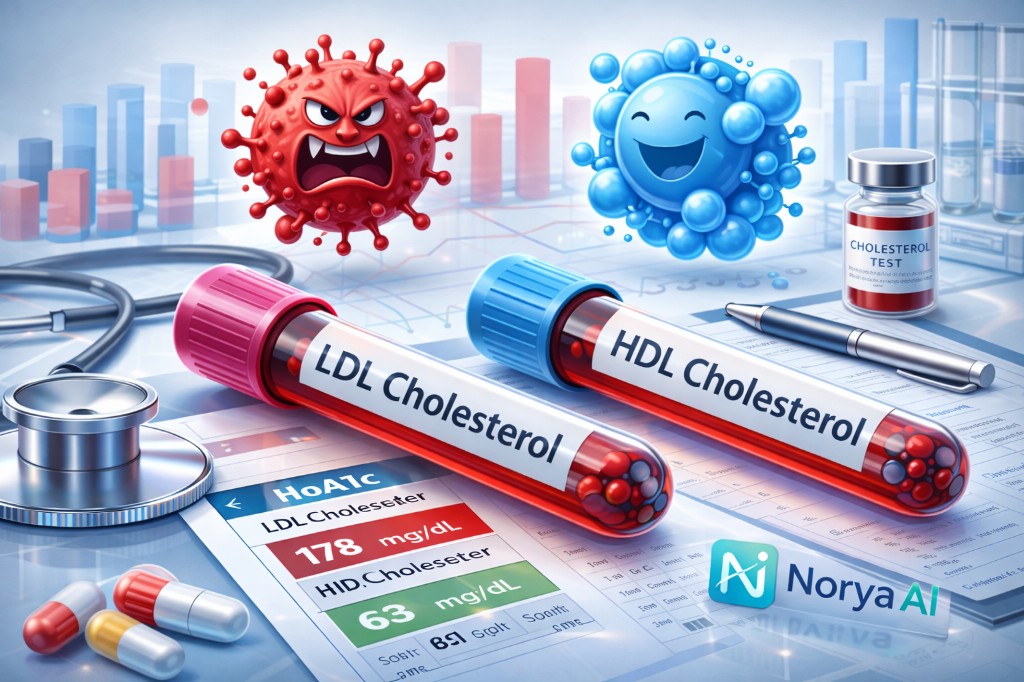
LDL (“bad”) Cholesterol — builds up in arteries; optimal < 100 mg/dL
Triglycerides — linked to heart disease and pancreatitis; normal < 150 mg/dL
Adults 20 and older should have a lipid panel every 4–6 years at minimum. Those with risk factors (family history, obesity, smoking) may need annual testing.
Thyroid Panel — TSH, T3 & T4
Your thyroid gland controls metabolism, energy, and body temperature. Thyroid disorders affect an estimated 12% of the population, and many cases go undiagnosed.
TSH (Thyroid-Stimulating Hormone) — the primary screening marker; normal 0.4–4.0 mIU/L
Free T4 — the main thyroid hormone; low = hypothyroidism
Free T3 — the more active hormone; useful when TSH is abnormal
Hypothyroidism (high TSH, low T4) causes fatigue, weight gain, cold intolerance, and depression. Hyperthyroidism (low TSH, high T4) causes weight loss, rapid heartbeat, and anxiety. Both are treatable once diagnosed.
Diabetes Screening — HbA1c & Fasting Glucose
Over 10% of adults worldwide have diabetes, and a significant proportion are undiagnosed. Two key markers provide the clearest picture:
Fasting Blood Glucose — measures blood sugar after an 8-12 hour fast. Normal < 100 mg/dL; prediabetes 100–125 mg/dL; diabetes ≥ 126 mg/dL
HbA1c (Glycated Hemoglobin) — reflects average blood sugar over 2–3 months. Normal < 5.7%; prediabetes 5.7–6.4%; diabetes ≥ 6.5%
HbA1c is especially valuable because it doesn't require fasting and isn't affected by day-to-day fluctuations. If either marker is in the prediabetic range, lifestyle changes can often prevent progression to type 2 diabetes.
Vitamin & Mineral Tests — D, B12, Iron & Ferritin
Nutrient deficiencies are surprisingly common, even in developed countries. The most important ones to test annually:
Vitamin D (25-OH) — essential for bones, immunity, and mood. Optimal: 30–60 ng/mL. Deficiency is widespread, especially in northern climates.
Vitamin B12 — critical for nerve function and red blood cell production. Deficiency causes fatigue, tingling, and cognitive issues. Common in vegetarians/vegans and older adults.
Iron & Ferritin — iron is needed for oxygen transport; ferritin reflects iron stores. Low ferritin is the earliest marker of iron deficiency, often appearing before anemia develops.
These tests are inexpensive and deficiencies are easy to correct with supplementation — but only if you know about them.
Inflammation Markers — CRP & ESR
Chronic low-grade inflammation is increasingly linked to heart disease, autoimmune conditions, and even cancer. Two accessible markers to monitor:
CRP (C-Reactive Protein) — produced by the liver in response to inflammation. hs-CRP < 1 mg/L = low cardiovascular risk; 1–3 mg/L = moderate; > 3 mg/L = high risk.
ESR (Erythrocyte Sedimentation Rate) — measures how quickly red blood cells settle. Elevated ESR suggests inflammation but is non-specific; useful for monitoring autoimmune diseases like rheumatoid arthritis or lupus.
If either marker is elevated without an obvious cause (like an acute infection), your doctor may investigate further with additional tests.
How Often to Test & How NoryaAI Helps
Testing frequency depends on your age, risk factors, and existing conditions:
Ages 18–30 — baseline CBC, metabolic panel, and lipid panel every 2–3 years; vitamin D and B12 if symptomatic
Ages 30–45 — annual CBC, CMP, lipid panel; add thyroid (TSH) and HbA1c every 2–3 years
Ages 45+ — full annual panel including CBC, CMP, lipids, thyroid, HbA1c, vitamin D, B12, ferritin, and CRP
Any age with risk factors (family history, obesity, chronic conditions) — more frequent, tailored testing
NoryaAI makes understanding your results effortless. Upload your lab report — PDF or photo — and NoryaAI will:
Identify every biomarker on your report
Compare each value to age- and sex-specific reference ranges
Flag abnormal results with clear, plain-language explanations
Generate a structured, doctor-ready health summary
No manual data entry. Upload and get your personalized analysis in minutes.
Trust & review
How this guide should be used
This article is educational and should be reviewed alongside our medical review, methodology, and transparency pages. Use it to prepare for a clinician conversation, not as a diagnosis.