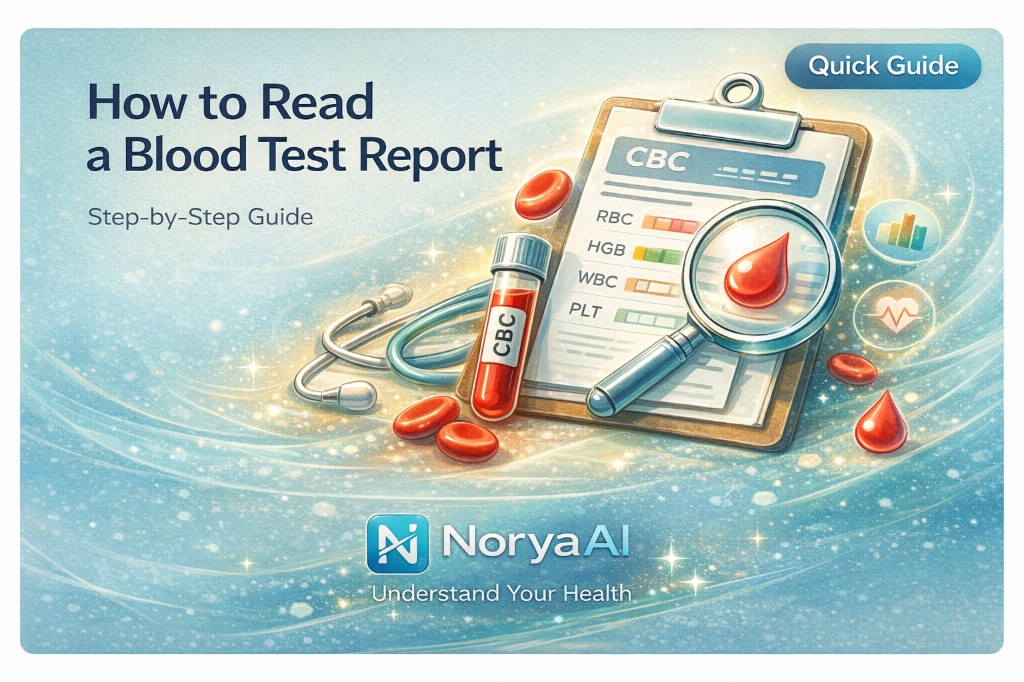
Complete Blood Count (CBC) Explained: The Ultimate Guide
Everything you need to know about your CBC results — RBC, WBC, hemoglobin, platelets, and more — explained in plain language.
Educational guide only — not medical advice. Always review results with a qualified clinician.
15 min read
··Last updated
NNoryaAI
What Is a Complete Blood Count (CBC)?
A Complete Blood Count (CBC) is one of the most commonly ordered blood tests worldwide. It measures the major components of your blood: red blood cells (RBCs), white blood cells (WBCs), platelets, hemoglobin, and hematocrit. Doctors use it as a general screening tool to evaluate your overall health, detect infections, diagnose anemia, and monitor existing conditions.
Understanding your CBC results can feel overwhelming — there are typically 15-20 values on a single report. This guide breaks down each component so you can walk into your next doctor's appointment prepared and informed.
Red Blood Cells (RBC)
Red blood cells carry oxygen from your lungs to every cell in your body and transport carbon dioxide back. The RBC count measures how many red blood cells are in a microliter of blood.
Normal ranges: Male: 4.7–6.1 million/µL · Female: 4.2–5.4 million/µL
High RBC (polycythemia) can be caused by dehydration, smoking, living at high altitude, or bone marrow disorders. Low RBC (anemia) may indicate iron deficiency, vitamin B12 deficiency, chronic disease, or blood loss.
Hemoglobin (Hb / Hgb)
Hemoglobin is the iron-containing protein inside red blood cells that actually binds and carries oxygen. It's one of the most important markers in your CBC.
Normal ranges: Male: 14–18 g/dL · Female: 12–16 g/dL
Low hemoglobin is the hallmark of anemia. Symptoms include fatigue, weakness, shortness of breath, and pale skin. High hemoglobin can occur with dehydration, chronic lung disease, or polycythemia vera.
Hematocrit (Hct)
Hematocrit measures the percentage of your blood volume that is occupied by red blood cells. It's closely related to hemoglobin and RBC count.
Normal ranges: Male: 40–54% · Female: 36–48%
High hematocrit can indicate dehydration or polycythemia. Low hematocrit usually accompanies anemia and has similar causes to low hemoglobin.
RBC Indices: MCV, MCH, MCHC
These indices describe the characteristics of your red blood cells and help classify the type of anemia:
MCV (Mean Corpuscular Volume): Average size of your red blood cells. Normal: 80–100 fL. Low MCV (microcytic) = iron deficiency; High MCV (macrocytic) = B12/folate deficiency.
MCH (Mean Corpuscular Hemoglobin): Average amount of hemoglobin per RBC. Normal: 27–33 pg.
MCHC (Mean Corpuscular Hemoglobin Concentration): Average concentration of hemoglobin in each RBC. Normal: 32–36 g/dL.
Example: If your MCV is 72 fL (low) and MCH is 24 pg (low), this pattern suggests iron deficiency anemia — the most common type worldwide.
RDW (Red Cell Distribution Width)
RDW measures how much variation there is in the size of your red blood cells. Normal range is typically 11.5–14.5%.
A high RDW means your red blood cells vary significantly in size (anisocytosis), which can indicate iron deficiency, vitamin deficiency, or mixed anemias. RDW is especially useful when combined with MCV to classify anemias.
White Blood Cells (WBC)
White blood cells are your immune system's soldiers. The total WBC count tells you how active your immune system is.
Normal range: 4,500–11,000 cells/µL
High WBC (leukocytosis) often indicates infection, inflammation, stress, allergic reactions, or in rare cases, leukemia. Low WBC (leukopenia) can be caused by viral infections, autoimmune diseases, bone marrow problems, or certain medications.
WBC Differential: Types of White Blood Cells
The differential breaks down WBCs into five types, each with a specific role:
Neutrophils (40–70%): First responders to bacterial infections. High = bacterial infection; Low = risk of infection.
Lymphocytes (20–40%): Fight viral infections and produce antibodies. High = viral infection, chronic inflammation; Low = HIV, immunodeficiency.
Monocytes (2–8%): Clean up dead cells and fight chronic infections. High = chronic inflammation, autoimmune disease.
Eosinophils (1–4%): Fight parasites and involved in allergic reactions. High = allergies, asthma, parasitic infections.
Basophils (0–1%): Involved in allergic and inflammatory responses. Rarely elevated on their own.
Platelets (PLT)
Platelets are tiny cell fragments essential for blood clotting. They rush to the site of a wound and form a plug to stop bleeding.
Normal range: 150,000–400,000/µL
Low platelets (thrombocytopenia) can cause easy bruising, prolonged bleeding, and petechiae (tiny red spots). Causes include viral infections, medications, autoimmune disorders, and liver disease. High platelets (thrombocytosis) can be reactive (infection, iron deficiency) or indicate a bone marrow disorder.
MPV (Mean Platelet Volume)
MPV measures the average size of your platelets. Normal range is typically 7.5–11.5 fL.
A high MPV with low platelet count suggests your bone marrow is producing young, large platelets to compensate for destruction (as in ITP). A low MPV may indicate bone marrow suppression.
When Should You Worry?
Most CBC abnormalities are mild and temporary. However, you should consult your doctor promptly if:
Hemoglobin is below 10 g/dL (moderate anemia)
WBC is above 20,000 or below 2,000
Platelets are below 50,000 (bleeding risk)
Multiple values are significantly abnormal
Abnormalities persist across multiple tests
Pro tip: A single abnormal value often means nothing in isolation. Trends over time and the combination of values matter more than any single number.
How NoryaAI Helps With Your CBC
NoryaAI reads your complete CBC report — whether it's a PDF from your lab or a photo — and automatically:
Identifies all 15-20+ CBC markers
Compares each value to age and sex-specific reference ranges
Flags abnormal values with clear explanations
Generates a structured, doctor-ready summary
Provides a health score based on your overall results
No manual data entry needed. Upload your report and get your analysis in minutes.
Trust & review
How this guide should be used
This article is educational and should be reviewed alongside our medical review, methodology, and transparency pages. Use it to prepare for a clinician conversation, not as a diagnosis.