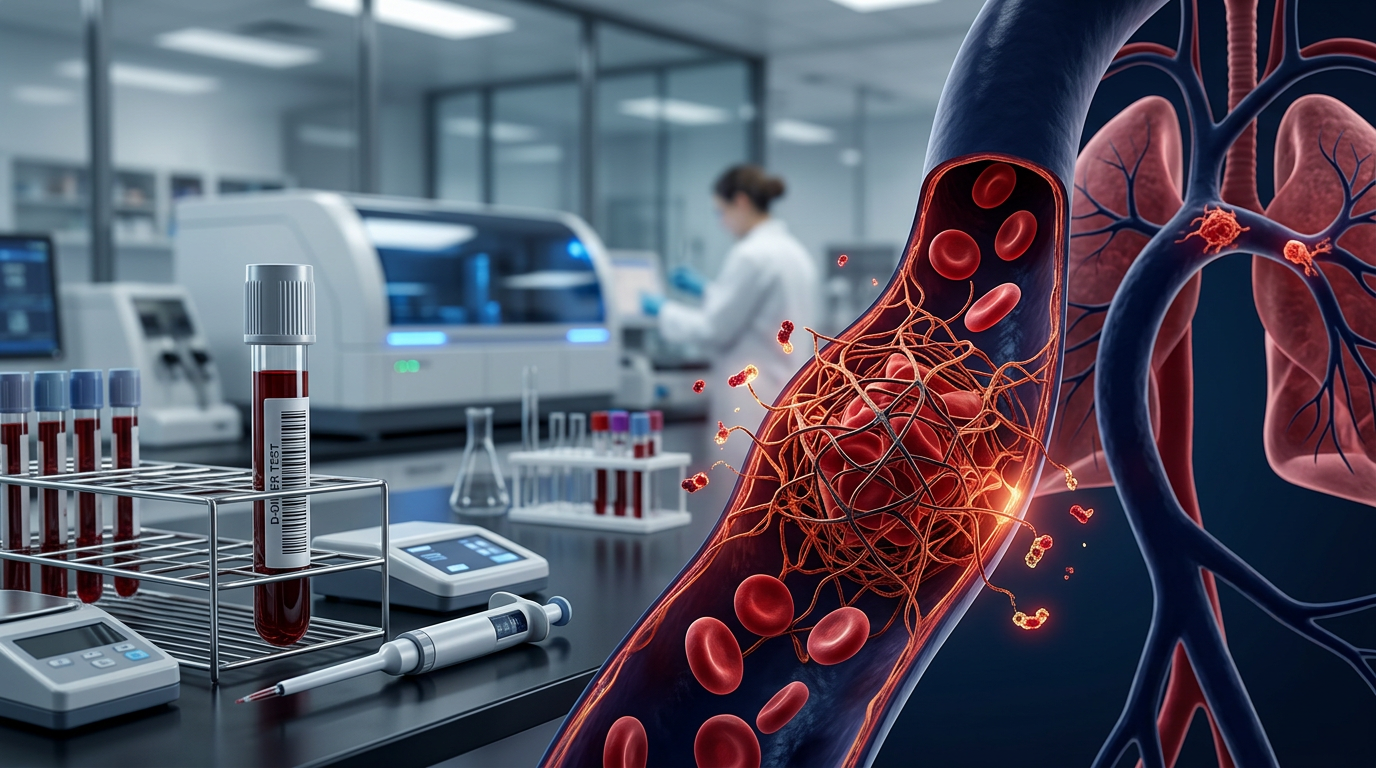
A high D-Dimer may indicate clotting activity; it is not a diagnosis on its own.
Educational guide only — not medical advice. Always review results with a qualified clinician.
7 min read
··Last updated
NNoryaAI
D-Dimer blood test: what your results mean
If your lab report shows an elevated D-Dimer level, you may be wondering what this test measures and whether you should be concerned. D-Dimer is a fibrin degradation product — a small protein fragment released when blood clots are broken down — and it plays a critical role in evaluating serious clotting disorders such as deep vein thrombosis (DVT) and pulmonary embolism (PE).
This guide explains what the D-Dimer blood test measures, normal reference ranges, causes of elevated D-Dimer, its clinical significance, and when you should see a doctor. Our goal is not to diagnose — it is to help you understand your results so you can have a more productive conversation with your healthcare provider.
The key clinical feature of the D-Dimer test is its high sensitivity but low specificity: a normal D-Dimer can help rule out DVT/PE in low-risk patients, but many different conditions can cause it to be elevated. Results must always be interpreted in clinical context.
What is D-Dimer?
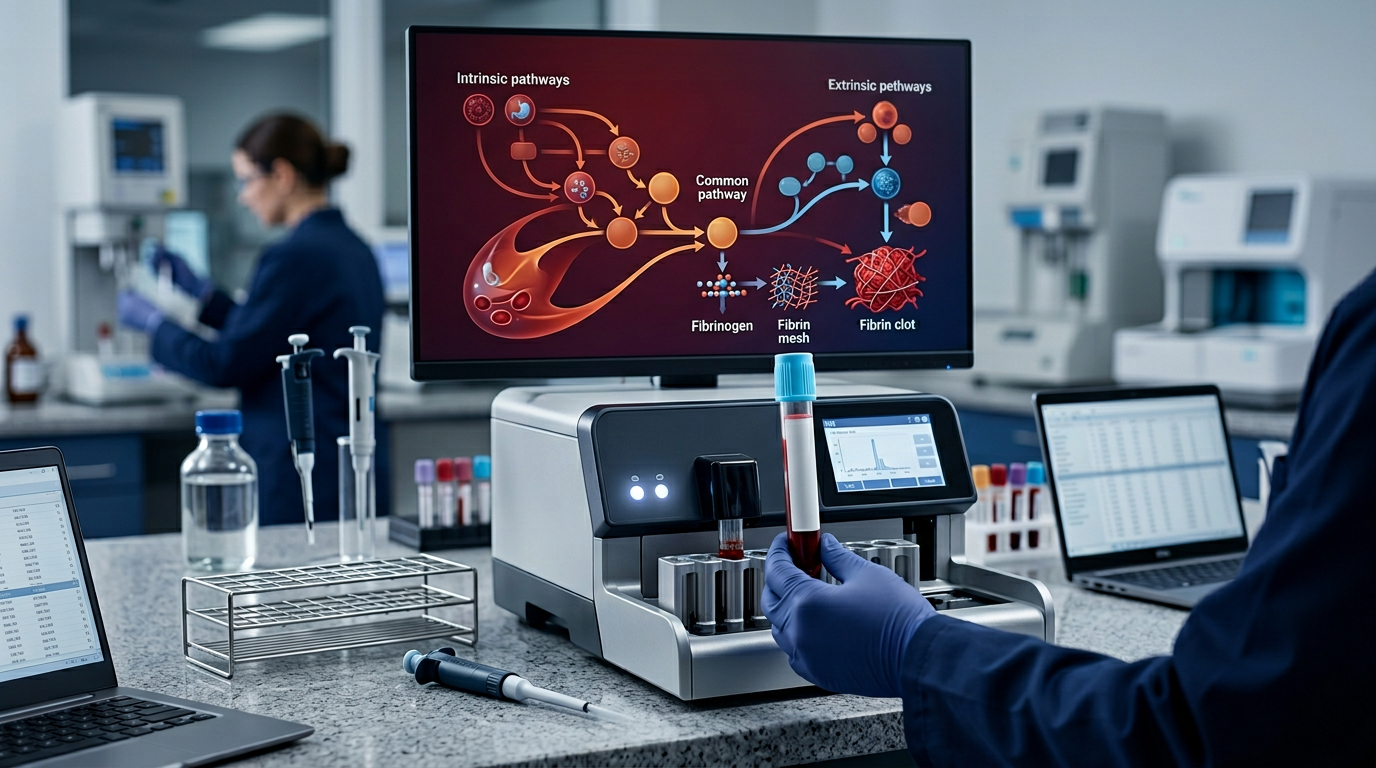
D-Dimer is a small protein fragment produced when a fibrin blood clot is broken down by plasmin. When the coagulation cascade is activated, fibrinogen is converted into fibrin strands that hold a clot together. Simultaneously, the fibrinolytic system works to dissolve the clot, and D-Dimer fragments are released into the blood during this process.
The presence of D-Dimer in the blood therefore indicates that both clot formation and clot breakdown have recently occurred. In healthy individuals, D-Dimer levels are very low because widespread clot formation and breakdown are not expected under normal physiological conditions.
The D-Dimer test is used primarily to help rule out thromboembolic disease (DVT, PE). A negative (low) D-Dimer result, combined with a low clinical probability, can exclude a clot with high accuracy. However, a positive (elevated) result does not diagnose a clot by itself — further imaging is needed for confirmation.
Normal D-Dimer levels (reference ranges)
D-Dimer is measured with a simple blood draw. The commonly used cut-off values are summarised below:
Unit
Normal upper limit
FEU (Fibrinogen Equivalent Units)
< 0.5 µg/mL
DDU (D-Dimer Units)
< 250 ng/mL
For patients over 50 years of age, an age-adjusted cut-off may be used: age × 10 ng/mL (DDU). For example, in a 70-year-old patient the threshold would be raised to 700 ng/mL. This adjustment reduces unnecessary imaging while maintaining diagnostic sensitivity.
Note that FEU and DDU units differ by approximately a factor of two — knowing which unit your laboratory uses is critical for correct interpretation. Always compare your result with your own laboratory’s reference range and unit system.
Causes of high D-Dimer
An elevated D-Dimer indicates active clot formation and breakdown somewhere in the body. However, many conditions can raise it:
Deep vein thrombosis (DVT): Blood clots in the leg veins are the most commonly investigated cause of elevated D-Dimer.
Pulmonary embolism (PE): Migration of a clot to the pulmonary arteries; D-Dimer testing is central to PE exclusion.
Disseminated intravascular coagulation (DIC): Widespread intravascular clotting with simultaneous bleeding; D-Dimer is markedly elevated.
Surgery and trauma: Tissue damage activates the coagulation cascade.
Pregnancy: D-Dimer rises physiologically during pregnancy and continues to increase with each trimester.
Cancer: Malignancies create a procoagulant state that increases D-Dimer.
Infection and sepsis: Severe infections activate the coagulation system.
Liver disease: Disrupted synthesis and breakdown of clotting factors can elevate D-Dimer.
Ageing: Baseline D-Dimer naturally rises with age, which is why age-adjusted cut-offs are recommended for patients over 50.
The D-Dimer test has high sensitivity but low specificity. A normal D-Dimer largely rules out clots in low-risk patients, but an elevated D-Dimer can occur in many conditions and does not confirm a diagnosis on its own.
Symptoms of DVT and PE
The two most common clinical scenarios prompting a D-Dimer test are suspected DVT and PE. Their typical symptoms include:
Deep vein thrombosis (DVT) symptoms:
Swelling, pain, and redness usually in one leg
Warmth over the affected area
Calf pain, especially when walking or flexing the foot upward
Pulmonary embolism (PE) symptoms:
Sudden shortness of breath
Chest pain (often pleuritic — worsens with deep breathing)
Rapid heart rate (tachycardia)
Haemoptysis (coughing up blood) — in some patients
Dizziness or feeling faint
These symptoms may indicate life-threatening conditions requiring emergency medical care. PE in particular can be fatal if not diagnosed and treated promptly.
Related tests
When D-Dimer is elevated or thromboembolic disease is suspected, additional tests are ordered:
PT/INR: Evaluates the extrinsic coagulation pathway; also used to monitor warfarin therapy.
aPTT: Evaluates the intrinsic coagulation pathway; important for heparin monitoring.
Fibrinogen: The main building block of clots; may be consumed in conditions like DIC.
Platelet count: Essential for assessing the balance between clotting and bleeding.
CT pulmonary angiography (CTPA): The gold-standard imaging study for diagnosing PE.
Doppler ultrasound: Used to visualise leg veins and detect DVT.
Interpreting these tests together with clinical probability scores (Wells score, Geneva score) is essential for accurate diagnosis and treatment planning.
When should you see a doctor?
Seek emergency medical attention if you experience:
Sudden shortness of breath or chest pain
Sudden swelling, pain, and redness in one leg
An elevated D-Dimer alongside the symptoms above
Coughing up blood or feeling faint
Pulmonary embolism is a life-threatening condition that requires immediate treatment. Untreated DVT can progress to PE if the clot migrates to the lungs. Early diagnosis and anticoagulant therapy (blood thinners) dramatically reduce the risk of complications.
An elevated D-Dimer is not a diagnosis in itself, but when combined with clinical suspicion it mandates further investigation. Always share your results with a qualified healthcare professional.
How NoryaAI helps you understand D-Dimer results
NoryaAI analyses your full blood-test report — including D-Dimer — in the context of your age, sex, and clinical background. Our AI-powered system highlights out-of-range values, summarises possible causes, and suggests questions you may want to ask your doctor.
Ready to get started? Upload your lab report for an instant analysis. Visit our pricing page to explore plan options. NoryaAI does not replace a physician; our goal is to empower you with information so your next medical consultation is more productive.
If your D-Dimer is elevated, do not panic — but if you have symptoms such as shortness of breath or leg swelling, seek emergency evaluation without delay.
Disclaimer
This content is for informational purposes only and does not constitute medical advice, diagnosis, or treatment. Always discuss your blood-test results with a qualified healthcare professional. NoryaAI is not a substitute for a medical consultation. Make all health-related decisions in consultation with your doctor. Visit our analysis page for preliminary insights into your results.
Trust & review
How this guide should be used
This article is educational and should be reviewed alongside our medical review, methodology, and transparency pages. Use it to prepare for a clinician conversation, not as a diagnosis.