Low Hemoglobin Meaning: What High or Low Hemoglobin Means
Hemoglobin is the oxygen-carrying protein in red blood cells. This guide explains low hemoglobin meaning, high hemoglobin causes, normal ranges, and when to follow up.
Educational guide only — not medical advice. Always review results with a qualified clinician.
8 min read
··Last updated
NNoryaAI
Hemoglobin levels: what high or low hemoglobin means
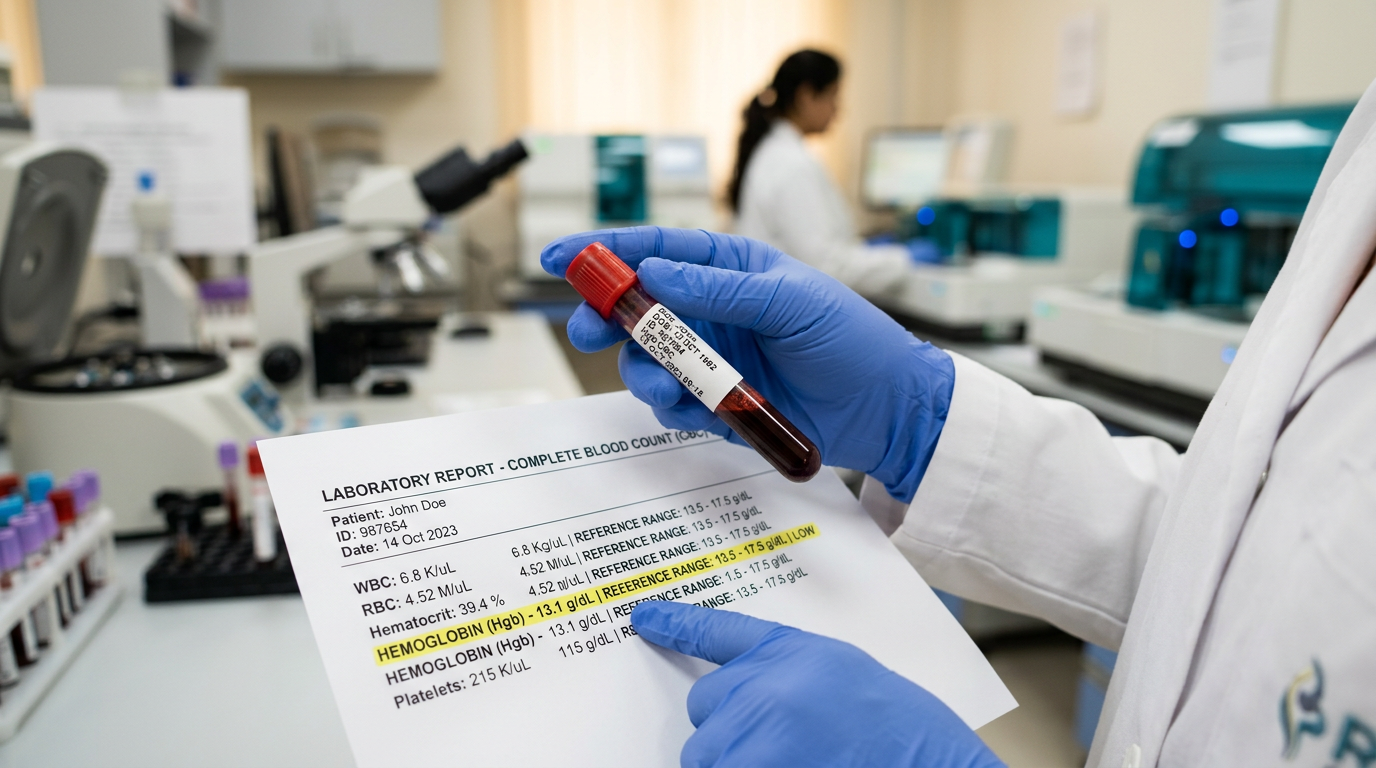
Hemoglobin (Hb) is the iron-containing protein inside red blood cells responsible for carrying oxygen from the lungs to every tissue in the body and returning carbon dioxide back to the lungs for exhalation. It is one of the most fundamental parameters measured in a complete blood count (CBC) and provides a direct indicator of the blood’s oxygen-carrying capacity.
When hemoglobin is too low, the condition is called anemia—a global health concern affecting roughly one-third of the world’s population according to the WHO. When hemoglobin is too high, blood viscosity increases and circulation problems can arise. Both situations may signal underlying medical conditions that require investigation.
This guide is educational and does not replace medical advice. Always discuss your hemoglobin results with a qualified healthcare professional.
What is hemoglobin and why does it matter?
Hemoglobin is a tetrameric protein composed of four subunits, each containing a heme group (a porphyrin ring with a central iron atom) and a globin chain. In adults, the predominant form is HbA (two alpha and two beta chains), making up about 95–98% of total hemoglobin. Each hemoglobin molecule can bind up to four oxygen molecules, and a single red blood cell contains roughly 270 million hemoglobin molecules.
Key functions of hemoglobin include:
Oxygen transport – binds O₂ in the lung alveoli and releases it in peripheral tissues where oxygen tension is low.
Carbon dioxide transport – carries approximately 20% of CO₂ produced by tissue metabolism back to the lungs as carbaminohemoglobin.
pH buffering – helps maintain blood pH within the narrow range of 7.35–7.45.
Hemoglobin levels depend on iron stores, vitamin B12 and folate status, bone marrow function, and erythropoietin (EPO) production by the kidneys. A single hemoglobin value does not diagnose a disease, but it is a critical screening tool for a wide range of conditions.
Normal hemoglobin ranges
Reference ranges vary by age, sex, and laboratory. The following table summarizes widely accepted adult values:
Group
Normal Range
Adult men
13.5–17.5 g/dL
Adult women
12.0–16.0 g/dL
Pregnant women
11.0–14.0 g/dL
Newborns
14.0–24.0 g/dL
Children (1–12 years)
11.0–14.5 g/dL
People living at high altitudes may have physiologically higher hemoglobin levels as a compensatory response to lower atmospheric oxygen pressure. Dehydration can also falsely elevate hemoglobin by reducing plasma volume. A single result should always be interpreted in clinical context.
Causes of high hemoglobin
Elevated hemoglobin (polycythemia) occurs when the blood’s oxygen-carrying capacity increases or when plasma volume decreases. The main causes include:
Dehydration – reduced plasma volume concentrates red blood cells, causing a relative rise in hemoglobin. This resolves with adequate fluid intake.
Polycythemia vera – a myeloproliferative neoplasm characterized by uncontrolled red blood cell production in the bone marrow. It is associated with the JAK2 V617F mutation in over 95% of cases.
Chronic lung disease (COPD, emphysema) – chronic hypoxia stimulates the kidneys to release more erythropoietin (EPO), driving increased red blood cell production.
Living at high altitude – lower atmospheric O₂ pressure triggers a compensatory increase in hemoglobin synthesis.
Smoking – carbon monoxide binds hemoglobin (forming carboxyhemoglobin) with 200× the affinity of oxygen, reducing functional oxygen delivery. The body compensates by producing more hemoglobin.
Congenital heart disease – cyanotic heart defects lead to chronic hypoxia and secondary polycythemia.
Elevated hemoglobin increases blood viscosity, which raises the risk of thrombosis (blood clots), stroke, and heart attack. In polycythemia vera, therapeutic phlebotomy (controlled blood removal) is a mainstay of treatment to keep hematocrit below target levels. Learn more about hematocrit.
Causes of low hemoglobin (anemia)
Low hemoglobin defines anemia, the most common blood disorder worldwide. The causes are broadly classified by the mechanism:
Iron deficiency anemia – the most prevalent form globally. Results from inadequate dietary iron, impaired absorption (celiac disease, gastric surgery), or chronic blood loss (heavy menstruation, gastrointestinal bleeding). Read more about iron tests.
Vitamin B12 and folate deficiency – causes megaloblastic anemia where red blood cells are abnormally large (macrocytic) due to impaired DNA synthesis.
Anemia of chronic disease – associated with cancer, chronic kidney disease, rheumatoid arthritis, and other inflammatory conditions that impair erythropoietin production and iron metabolism.
Blood loss – acute (trauma, surgery) or chronic (GI bleeding, hemorrhoids).
Thalassemia – inherited disorders of globin chain synthesis, particularly common in Mediterranean, Middle Eastern, and Southeast Asian populations.
Aplastic anemia – bone marrow failure resulting in reduced production of all blood cell lines.
Hemolytic anemias – accelerated destruction of red blood cells (autoimmune, sickle cell disease, G6PD deficiency).
Treatment depends on the underlying cause: iron supplementation for iron deficiency, B12 injections for B12 deficiency, erythropoiesis-stimulating agents for chronic kidney disease, and blood transfusion for severe anemia. Identifying and correcting the root cause is essential for long-term management.
Symptoms of high and low hemoglobin
Low hemoglobin (anemia) symptoms:
Fatigue and weakness
Pale skin, nail beds, and mucous membranes
Shortness of breath, especially on exertion
Dizziness and headache
Rapid heartbeat (tachycardia) and palpitations
Cold hands and feet
Brittle nails and hair loss (particularly in iron deficiency)
Pica (craving non-food items such as ice or dirt)
High hemoglobin symptoms:
Headache and dizziness
Blurred or impaired vision
Facial flushing (ruddy complexion)
Itching, especially after a warm shower (classic in polycythemia vera)
Mild anemia may be asymptomatic for extended periods; severe anemia (Hb < 7 g/dL) can lead to heart failure if untreated. High hemoglobin should not be ignored either, as it significantly elevates the risk of life-threatening blood clots.
Related blood tests
Hemoglobin is never interpreted in isolation. It is evaluated alongside other complete blood count parameters:
Hematocrit (Hct) – the percentage of blood volume occupied by red blood cells; moves in parallel with hemoglobin. Learn more about hematocrit.
Red blood cell count (RBC) – the total number of erythrocytes per unit volume.
MCV (Mean Corpuscular Volume) – average size of red blood cells; helps classify anemia as microcytic (low MCV, e.g. iron deficiency), normocytic, or macrocytic (high MCV, e.g. B12 deficiency).
MCH and MCHC – mean hemoglobin content and concentration per red blood cell.
RDW (Red Cell Distribution Width) – measures variability in red blood cell size.
Iron panel – serum iron, ferritin, TIBC (total iron-binding capacity), transferrin saturation. Read more about iron.
Reticulocyte count – indicates how fast the bone marrow is producing new red blood cells.
Vitamin B12 and folate – evaluated when macrocytic anemia is suspected.
The combination of these tests helps pinpoint the type and cause of anemia. For example, low hemoglobin + low MCV + low ferritin strongly suggests iron deficiency anemia, while low hemoglobin + high MCV + low B12 points to vitamin B12 deficiency.
When to see a doctor
Consult a healthcare professional if:
Your hemoglobin result is above or below the reference range
You experience unexplained fatigue, weakness, pale skin, or shortness of breath
You notice heavy menstrual bleeding, blood in stool, or blood in urine
You develop sudden severe headache, vision changes, or chest pain
You have a known chronic condition and notice a significant change in hemoglobin
Emergency: Hemoglobin below 7 g/dL or active hemorrhage may require emergency intervention including blood transfusion. Extremely high hemoglobin (>20 g/dL) also warrants urgent evaluation due to thrombosis risk.
How Norya helps
Norya does not diagnose—we help you prepare for your doctor visit. Upload your blood test report at noryaai.com/analyze and our AI engine automatically extracts hemoglobin, hematocrit, MCV, and other biomarkers, compares them against reference ranges, and generates a clear, structured report.
Whether you are reviewing blood test results for the first time or monitoring a chronic condition, Norya organises your results to help you have a more informed conversation with your doctor. For subscription options, visit our pricing page.
Disclaimer
This guide is for informational purposes only and does not replace medical advice or diagnosis. Always discuss your results with a healthcare professional. Start analysis with Norya
Trust & review
How this guide should be used
This article is educational and should be reviewed alongside our medical review, methodology, and transparency pages. Use it to prepare for a clinician conversation, not as a diagnosis.