High bilirubin may indicate liver or red blood cell breakdown issues; it is not a diagnosis on its own.
Educational guide only — not medical advice. Always review results with a qualified clinician.
7 min read
··Last updated
NNoryaAI
High bilirubin: what does it mean? A comprehensive guide
Bilirubin is a yellow-orange pigment produced from the breakdown of haemoglobin in ageing red blood cells. It is a core component of liver function tests and provides valuable insight into the health of the liver, bile ducts, and red blood cell turnover. Elevated bilirubin in the blood is called hyperbilirubinaemia and may manifest as yellowing of the skin and eyes (jaundice).
The causes of high bilirubin range from liver disease and haemolytic anaemia to bile duct obstruction and genetic conditions such as Gilbert syndrome. Neonatal jaundice is also extremely common in newborns.
This guide is educational and does not replace medical advice.
What is bilirubin and how is it produced?
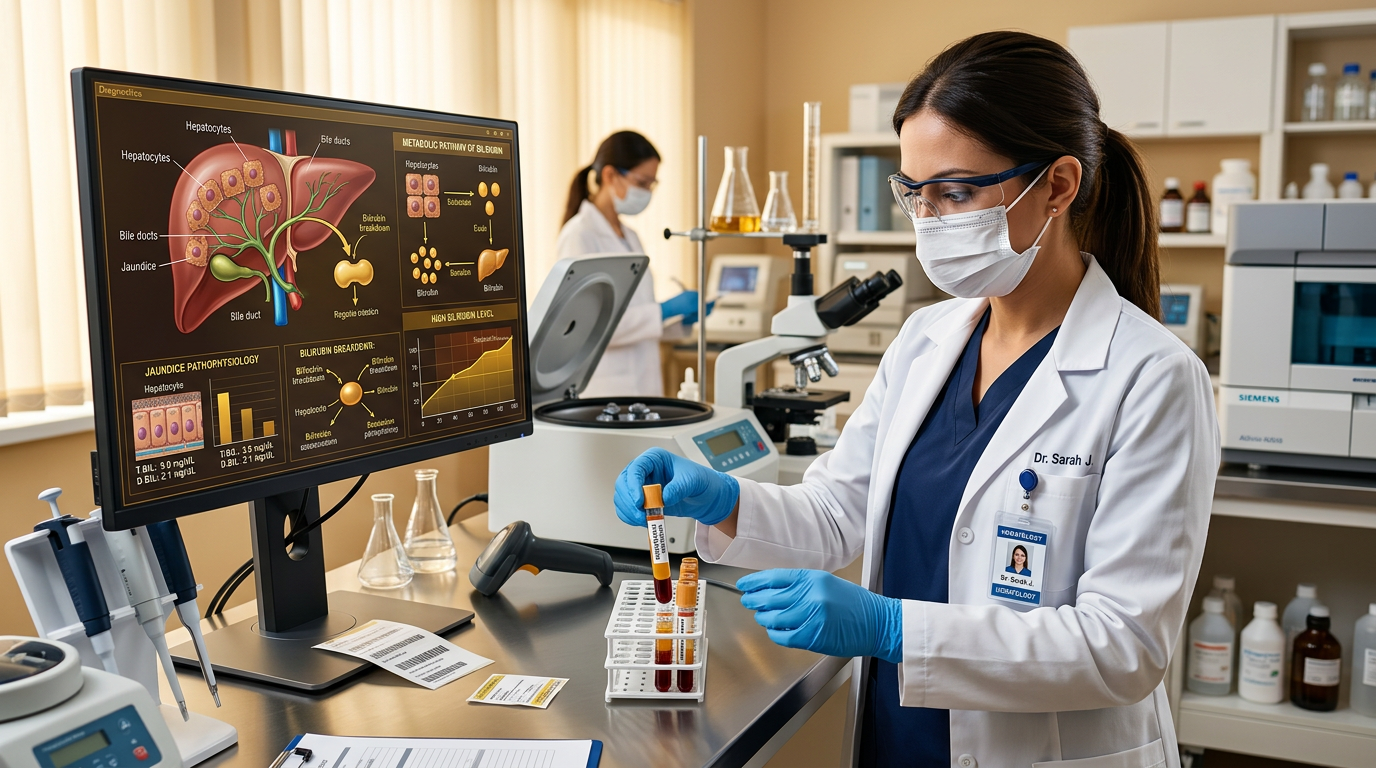
Bilirubin is formed when the haem component of haemoglobin is broken down by the reticuloendothelial system (primarily in the spleen and liver). Approximately 80% of daily bilirubin production comes from red blood cell haemoglobin; the remaining 20% comes from myoglobin, cytochromes, and other haem proteins.
The key steps in bilirubin metabolism are:
Production – haem is converted to biliverdin by haem oxygenase, then to unconjugated (indirect) bilirubin by biliverdin reductase.
Transport – unconjugated bilirubin is water-insoluble and travels in the blood bound to albumin.
Conjugation – in hepatocytes, the enzyme UDP-glucuronosyltransferase (UGT1A1) conjugates bilirubin with glucuronic acid, producing conjugated (direct) bilirubin.
Excretion – conjugated bilirubin is excreted into bile, enters the intestine, and is converted by bacteria to urobilinogen. Some is excreted as stercobilin in faeces (brown colour); some is reabsorbed and excreted as urobilin in urine (yellow colour).
A disruption at any step of this pathway can cause bilirubin to rise.
Direct vs. indirect bilirubin
Bilirubin is measured in two main fractions:
Indirect (unconjugated) bilirubin – the form that has not yet been processed by the liver. It is water-insoluble. Elevation typically indicates excessive red blood cell destruction (haemolysis) or impaired hepatic conjugation (e.g. Gilbert syndrome).
Direct (conjugated) bilirubin – the liver-processed, water-soluble form. Elevation usually indicates liver damage or bile duct obstruction (cholestasis), because the conjugated bilirubin cannot be excreted normally.
Total bilirubin = direct + indirect. Laboratory reports typically provide total and direct values; indirect is calculated by subtraction. Knowing which fraction is elevated is critical for determining the underlying cause.
Normal bilirubin ranges
Parameter
Normal Range
Total bilirubin
0.1–1.2 mg/dL (1.7–20.5 µmol/L)
Direct (conjugated) bilirubin
0–0.3 mg/dL (0–5.1 µmol/L)
Indirect (unconjugated) bilirubin
0.1–0.9 mg/dL
Clinical jaundice typically becomes apparent when total bilirubin exceeds 2.5–3 mg/dL. Reference ranges may vary slightly between laboratories.
Causes of high bilirubin
Elevated bilirubin is classified into three main categories:
Gilbert syndrome and Crigler-Najjar syndrome (conjugation defects)
3. Post-hepatic (obstructive) causes – direct bilirubin elevated:
Gallstones (cholelithiasis)
Bile duct stricture or tumour
Pancreatic head tumour
Primary sclerosing cholangitis
Identifying which fraction is predominantly elevated guides the clinician’s diagnostic workup.
Jaundice and bilirubin
Jaundice (icterus) is the yellow-green discolouration of the skin, mucous membranes, and sclerae (whites of the eyes) caused by bilirubin accumulation in tissues. It typically becomes clinically visible when total bilirubin exceeds 2.5–3 mg/dL. The first sign is usually scleral icterus.
Associated findings may include:
Dark urine (tea-coloured) – direct bilirubin is excreted by the kidneys
Pale (acholic) stools – absence of stercobilin due to bile duct obstruction
Pruritus (itching) – bile acid deposition in the skin during cholestasis
Abdominal pain – especially right upper quadrant pain in gallstone disease
In newborns, physiological jaundice begins around day 2–3 of life and usually resolves within 1–2 weeks. However, very high levels (>20 mg/dL) carry a risk of neurotoxicity (kernicterus) and may require phototherapy or exchange transfusion.
Gilbert syndrome
Gilbert syndrome is the most common inherited disorder of bilirubin metabolism, caused by reduced activity of the UGT1A1 enzyme. It affects approximately 3–7% of the general population and is typically discovered in adolescence or early adulthood.
Key features:
Mild, intermittent unconjugated (indirect) hyperbilirubinaemia (usually 1–3 mg/dL, occasionally up to 5 mg/dL)
Exacerbations triggered by fasting, stress, exercise, or illness
Liver function tests (ALT, AST, ALP) are normal
No evidence of haemolysis (reticulocytes, haptoglobin, LDH are normal)
No treatment required; prognosis is excellent
Gilbert syndrome is benign and does not cause liver damage. However, it can affect the metabolism of certain drugs (particularly those metabolised by UGT1A1, such as irinotecan), so it is important for your doctor to be aware of the condition.
Newborn jaundice (neonatal hyperbilirubinaemia)
Neonatal jaundice is extremely common, occurring in approximately 60% of term infants and 80% of preterm infants. Contributing factors include the rapid breakdown of foetal haemoglobin (HbF), the immature conjugation capacity of the newborn liver, and increased enterohepatic circulation.
Physiological jaundice appears on day 2–3 of life, peaks around day 4–5, and resolves within 1–2 weeks. Pathological jaundice is jaundice that appears within the first 24 hours, rises rapidly, or persists beyond two weeks.
Very high bilirubin levels (>20–25 mg/dL) in newborns increase the risk of kernicterus (bilirubin encephalopathy)—permanent neurological damage caused by bilirubin deposition in brain tissue. Treatment options include phototherapy (blue light) and, in severe cases, exchange transfusion.
Related tests
When investigating elevated bilirubin, the following tests are commonly ordered:
ALT and AST – hepatocellular damage markers
ALP – cholestatic damage marker
GGT – helps distinguish the source of ALP elevation
Albumin – reflects liver synthetic function
Complete blood count – to investigate haemolysis
Reticulocyte count – elevated in haemolytic anaemia
Haptoglobin and LDH – haemolysis markers
Direct and indirect Coombs test – to investigate autoimmune haemolysis
Abdominal ultrasound – to evaluate gallstones and bile duct dilatation
The combination of these tests helps classify the cause of elevated bilirubin as pre-hepatic, hepatic, or post-hepatic.
When to see a doctor
See your doctor if:
Your bilirubin level is elevated
You notice yellowing of your skin or eyes
Your urine is dark (tea-coloured)
Your stools are unusually pale or clay-coloured
You have right upper abdominal pain, nausea, or itching
Emergency: Jaundice with fever, severe abdominal pain, altered mental status, or deep jaundice in a newborn requires emergency medical evaluation.
How Norya helps
Norya does not diagnose—we help you prepare for your doctor visit. Upload your blood test report at noryaai.com/analyze and our AI engine automatically extracts total, direct, and indirect bilirubin along with ALT, AST, ALP, GGT, and other liver markers, compares them against reference ranges, and generates a clear, structured report.
This guide is for informational purposes only and does not replace medical advice or diagnosis. Always discuss your results with a healthcare professional. Start analysis with Norya
Trust & review
How this guide should be used
This article is educational and should be reviewed alongside our medical review, methodology, and transparency pages. Use it to prepare for a clinician conversation, not as a diagnosis.